Few Grand Justices Issue Constitutional Interpretation, Allegedly to Serve Ruling Party
China Times Editorial, December 20, 2025
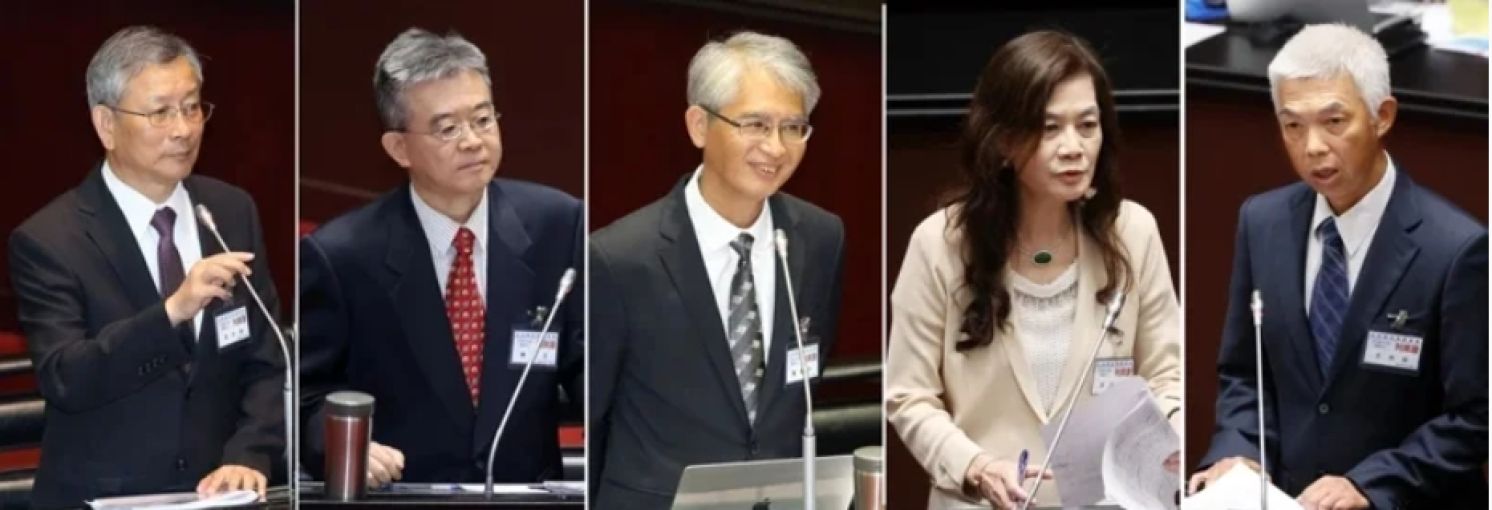
Five grand justices of the Constitutional Court handed down the earth-shaking Constitutional Judgment No. 1 of 2025, declaring in a single stroke that “the amendment to the Constitutional Court Procedure Act is unconstitutional and immediately void,” instantly reviving a paralyzed Constitutional Court at full strength. This sensational ruling is steeped in political overtones, forcibly reducing procedural justice to a mere technicality and effectively making clear that the Constitutional Court intends to act as the ruling party’s best assisting hand. It not only shakes the foundations of constitutional governance but also drags democratic rule of law down with it.
Last year, the opposition amended the Constitutional Court Procedure Act in response to a political reality in which the executive was weak and the legislature strong, and under President Lai Ching-te and Premier Cho Jung-tai, constitutional interpretations were frequently invoked to counter laws passed by opposition legislators. The opposition therefore raised the quorum for deliberation to at least 10 justices and required nine votes to declare a law unconstitutional, with the aim of preventing a small number of justices from hijacking the will of the majority in highly political cases.
Yet the constitutional judgment led this time by five grand justices—Lu Tai-lang, Hsieh Ming-yang, Chen Chung-wu, You Bo-hsiang, and Tsai Tsai-chen—amounts to saying, “If you won’t let me convene, I’ll change the rules.” More crucially, they deducted the three grand justices who refused to participate in deliberation—Tsai Tsung-chen, Yang Hui-chin, and Chu Fu-mei—from the “existing total,” thereby turning five grand justices into a “full quorum.” Once this method of calculation was applied, the court effectively issued itself a license to operate and announced that constitutional adjudication would degenerate into an extension of political contestation.
The dissenting opinions of three grand justices including Tsai made the core issue unmistakably clear: the question is not whether your judgment is reasonable, but whether you are qualified to render it. A court that is not lawfully constituted lacks adjudicatory authority; laws validly promulgated by the president are binding on the grand justices as well until they are lawfully repealed or declared void by a legally constituted court. There is no such thing as “organizational autonomy” or “procedural autonomy” that would allow the court to unilaterally alter statutory thresholds.
Judgments of the Constitutional Court are binding on all state organs nationwide. If even the Constitutional Court can say, “Set the law aside; I need to operate first,” then who among law-enforcement authorities at any level will still feel the need to follow procedures? This case is particularly a clear instance of a “self-interested case,” as the amendment directly targeted the operating thresholds of the Constitutional Court, demanding an even higher degree of self-restraint. Yet the five grand justices chose self-exoneration instead, leaving judicial credibility in tatters.
What the judiciary fears most is being labeled by political color, and fears even more proving that color through its actions. By issuing a plainly unlawful constitutional judgment, the five grand justices effectively made a naked declaration: “We are DPP justices,” completely subverting constitutional jurisprudence. The essence of separation of powers lies in each branch being bound by rules: legislators may amend laws, the executive may seek reconsideration, and the people may respond with their ballots. But once the Constitutional Court takes sides, “adjudicating according to law” is rewritten as “I decide.”
Even more troubling is the sensitive political timing. As the Lai-Cho system faces major controversies over refusal to countersign legislation and non-implementation by the administration, the Constitutional Court moved to rescue itself in an extremely contentious manner. The objective effect is no different from bailing out the ruling party and opening a new channel for the Lai-Cho system to confront the opposition. In the future, whenever the ruling party is dissatisfied with laws passed by the opposition, it can simply request constitutional interpretation and shift the political battlefield into the judicial arena.
The constitutional judgment unilaterally rendered by the five grand justices is bound to trigger a vicious cycle, with partisan confrontation only continuing to escalate. Signals have already emerged within the Democratic Progressive Party (DPP) that controversial bills previously passed on third reading by the blue and white camps—such as the Act Governing the Allocation of Government Revenues and Expenditures, the Election and Recall Act, and legislation on pay raises and pensions—may successively be sent to the Constitutional Court for review and even declared unconstitutional. The opposition, for its part, views this as the revival of a “judicial veto,” effectively resetting the will of the parliamentary majority.
A foreseeable standard script for future legislative confrontation is that the opposition overwhelms votes in the legislature, Premier Cho responds with dissatisfaction by first seeking reconsideration and then requesting constitutional interpretation; as long as a bill does not align with DPP interests, even legislation beneficial to the nation and the people will be stuck for extended periods “under review.” When every political conflict can be judicialized, President Lai and Premier Cho will no longer need to compromise with the opposition—only to outsource disputes to the Constitutional Court and leave the costs to society as a whole.
From: https://www.chinatimes.com/opinion/20251220002932-262101?chdtv